Why Sample Flow Rates are Critically Important
Whether you have lots of education and IAQ experience or are just starting out,
it's important to make sure that you are using your sampling products and supplies
in the correct manner. You need to know and understand the manufacturer's
instructions for the products and sampling supplies that you are using for your
IAQ investigations and sampling.
If you misuse the sampling equipment you could put the results you receive from
your accredited lab into question. To prevent misuse, EMLab P&K Products tries
to provide as much information as possible about the equipment and supplies that
customers purchase or rent from us. You can also receive information about
sampling in many ways from EMLab P&K including: our knowledgeable staff,
IAQ training courses,
IAQ Pocket Guide, information packets sent with every shipment,
and information available on our website and online store.
A common question we receive is about sampling flow rates. To obtain accurate
results, you must know your sampling apparatus' flow rate requirement for
sampling and make sure that your pump is capable of pulling that flow rate.
For example, some common flow rates include:
| Apparatus |
Proper Flow Rates |
| Air-O-Cell® |
15 Lpm |
| MoldSNAP™ |
5 Lpm |
| Micro5 Microcell |
5 Lpm |
| A6® Single Stage Microbial Sampler |
28 Lpm |
Air Sampling Cassettes

A6® Single Stage Microbial Sampler

It's critically important to follow the recommended sampling flow rates
because the manufacturer designed the sampling apparatus to work at its greatest
collection efficiency when using the recommended flow rates. If you don't sample
at the flow rate that the manufacturer recommends, you will not capture the
particulate sizes that the cassette is designed to pull in during sampling.
The flow rate also determines the rate that the particulates impact on the
sampling adhesive in a slide impaction cassette or on the agar in a petri dish.
If you sample at a higher than recommended flow rate, you could damage the
bioaerosols or cause "bounce off" (when particles bounce off the
adhesive and don't stick on the slide). If you sample at a lower than recommended
flow rate, it could result in the smaller bioaerosols not impacting hard enough
to stay on the adhesive or agar.
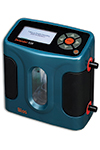
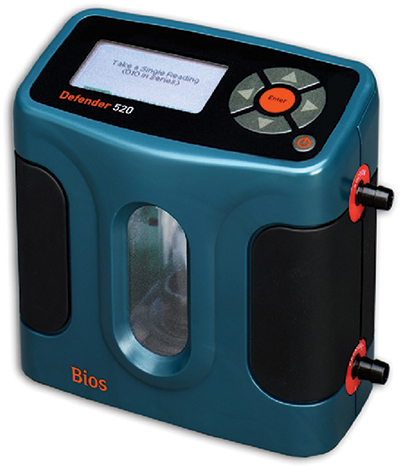
This is why it is also vitally important to primary calibrate your sampling
pump regularly. To ensure that you are pulling the flow rate you set your pump
at, you need to use a NIST (National Institute of Standards and Technology)
Certified Primary Calibrator such as a Bios Defender.
Most rotameters that are attached to pumps are typically considered as secondary
means of calibration and are not NIST-certified; thus, the reason why primary calibration is needed.
Bios Defender 510
It is also important to pay attention to sampling times because most sampling
cassettes are sensitive to overloading. Most sampling cassettes have a chart
with different sampling times that are dependent on the environmental sampling
conditions. If you are in an environment that has a lot of particulates, you
will require less sampling time to ensure that your cassettes are not overloaded.
On the other hand, environments with fewer particulates require longer sampling
times to ensure you have enough of a sample for the lab to analyze.
In conclusion, it's important to make sure you are using your IAQ sampling
equipment and supplies properly as directed by the manufacturer. Always refer
to instruction manuals or spec sheets and your certification training for proper
sampling techniques. If you have any questions, please contact the highly
knowledgeable staff at EMLab P&K anytime. We are here to serve you and our industry.
Happy sampling!
If you have questions about air sampling pumps,
sampling cassettes,
or other IAQ testing products or supplies, contact EMLab P&K Products
by phone at (888) 836-5227 or by email at
[email protected].